
Skip to content
CCEH
Bringing together Centers of Excellence to advance benign hematology research
CCEH
  • Centers
    • Cincinnati Center of Excellence in Molecular Hematology
    • Fred Hutchinson Cancer Center
    • Indiana University Cooperative Center of Excellence in Hematology
    • Center for Iron & Heme Disorders at The University of Utah School of Medicine
    • Yale Cooperative Center of Excellence in Hematology
  • News
    • Events
    • Multiomics Monday 2025
    • Featured Publications
    • Highlighted Cores
    • Quarterly Newsletter
  • Funding
    • Funding
    • Current P&F Projects
    • P&F Project Abstracts
  • Careers
  • Services
  • Protocols
  • Videos
    • Video Directory
    • CCEH YouTube Channel
  • About
Search:
  • Centers
    • Cincinnati Center of Excellence in Molecular Hematology
    • Fred Hutchinson Cancer Center
    • Indiana University Cooperative Center of Excellence in Hematology
    • Center for Iron & Heme Disorders at The University of Utah School of Medicine
    • Yale Cooperative Center of Excellence in Hematology
  • News
    • Events
    • Multiomics Monday 2025
    • Featured Publications
    • Highlighted Cores
    • Quarterly Newsletter
  • Funding
    • Funding
    • Current P&F Projects
    • P&F Project Abstracts
  • Careers
  • Services
  • Protocols
  • Videos
    • Video Directory
    • CCEH YouTube Channel
  • About

Krause Lab Blood Publication

You are here:
  1. Home
  2. Featured Publication
  3. Krause Lab Blood Publication
Congratulations to the Krause lab for their recent publication
in Blood
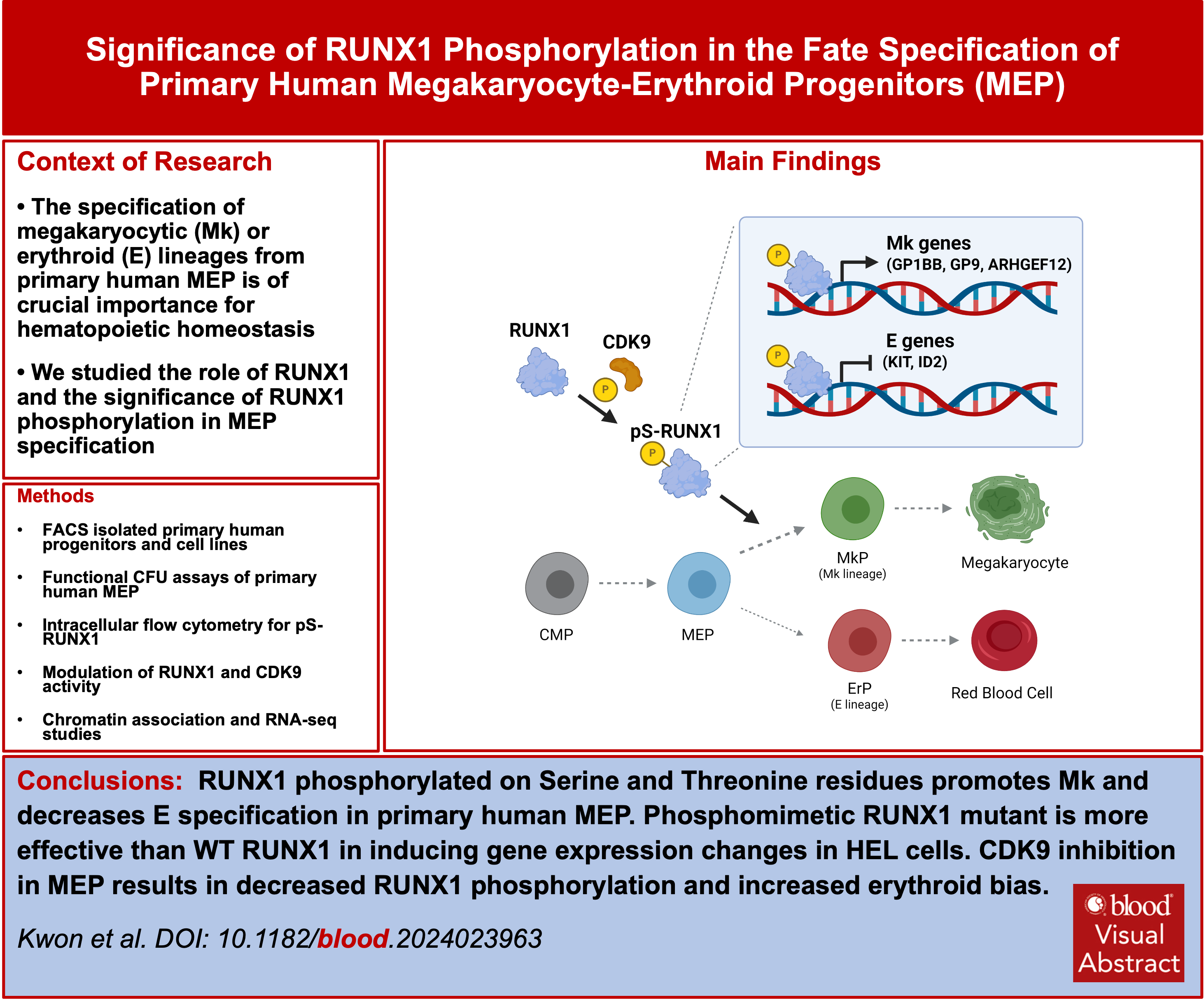
CDK9 phosphorylates RUNX1 to promote megakaryocytic fate in megakaryocytic-erythroid progenitors
Link to Publication ▸

Abstract Text:

The specification of megakaryocytic (Mk) or erythroid (E) lineages from primary human megakaryocytic-erythroid progenitors (MEPs) is crucial for hematopoietic homeostasis, yet the underlying mechanisms regulating fate specification remain elusive. In this study, we identify RUNX1 as a key modulator of gene expression during MEP fate specification. Overexpression of RUNX1 in primary human MEPs promotes Mk specification, whereas pan-RUNX inhibition favors E specification. Although total RUNX1 levels do not differ between Mk progenitors (MkPs) and E progenitors (ErPs), there are higher levels of serine-phosphorylated RUNX1 in MkPs than ErPs, and mutant RUNX1 with phosphorylated-serine/threonine mimetic mutations (RUNX1-4D) significantly enhances the functional efficacy of RUNX1. To model the effects of RUNX1 variants, we use human erythroleukemia (HEL) cell lines expressing wild-type (WT), phosphomimetic (RUNX1-4D), and nonphosphorylatable (RUNX1-4A) mutants showing that the 3 forms of RUNX1 differentially regulate expression of 2625 genes. Both WT and RUNX1-4D variants increase expression in 40%, and decrease expression in another 40%, with lesser effects of RUNX1-4A. We find a significant overlap between the upregulated genes in WT and RUNX1-4D-expressing HEL cells and those upregulated in primary human MkPs vs MEPs. Although inhibition of known RUNX1 serine/threonine kinases does not affect phosphoserine RUNX1 levels in primary MEPs, specific inhibition of cyclin dependent kinase 9 (CDK9) in MEPs leads to both decreased RUNX1 phosphorylation and increased E commitment. Collectively, our findings show that serine/threonine phosphorylation of RUNX1 promotes Mk fate specification and introduce a novel kinase for RUNX1 linking the fundamental transcriptional machinery with activation of a cell type-specific transcription factor.

Share this post
Share on FacebookShare on Facebook Share on XShare on X

Funding Agencies

National Institute of Diabetes and Digestive and Kidney Diseases

Social Media

  • Facebook
  • X
  • Instagram
  • Bluesky
  • YouTube

Centers

Cincinnati Center of Excellence in Molecular Hematology

Fred Hutchinson Cancer Center

Indiana University Cooperative Center of Excellence in Hematology

Center for Iron & Heme Disorders at The University of Utah School of Medicine

Yale Cooperative Center of Excellence in Hematology

Contact

Cindy N. Roy, Ph.D.

Program Director, Division of Kidney, Urologic, & Hematologic Diseases,
Cooperative Centers of Excellence in Hematology

CCEH

Copyright © 2026

Go to Top
×