ASGCT – Poster Presentation by Megha Gupta, Staff Scientist | Fred Hutch-Cell Manipulations Tools Core
May 11-15, 2026 | Boston
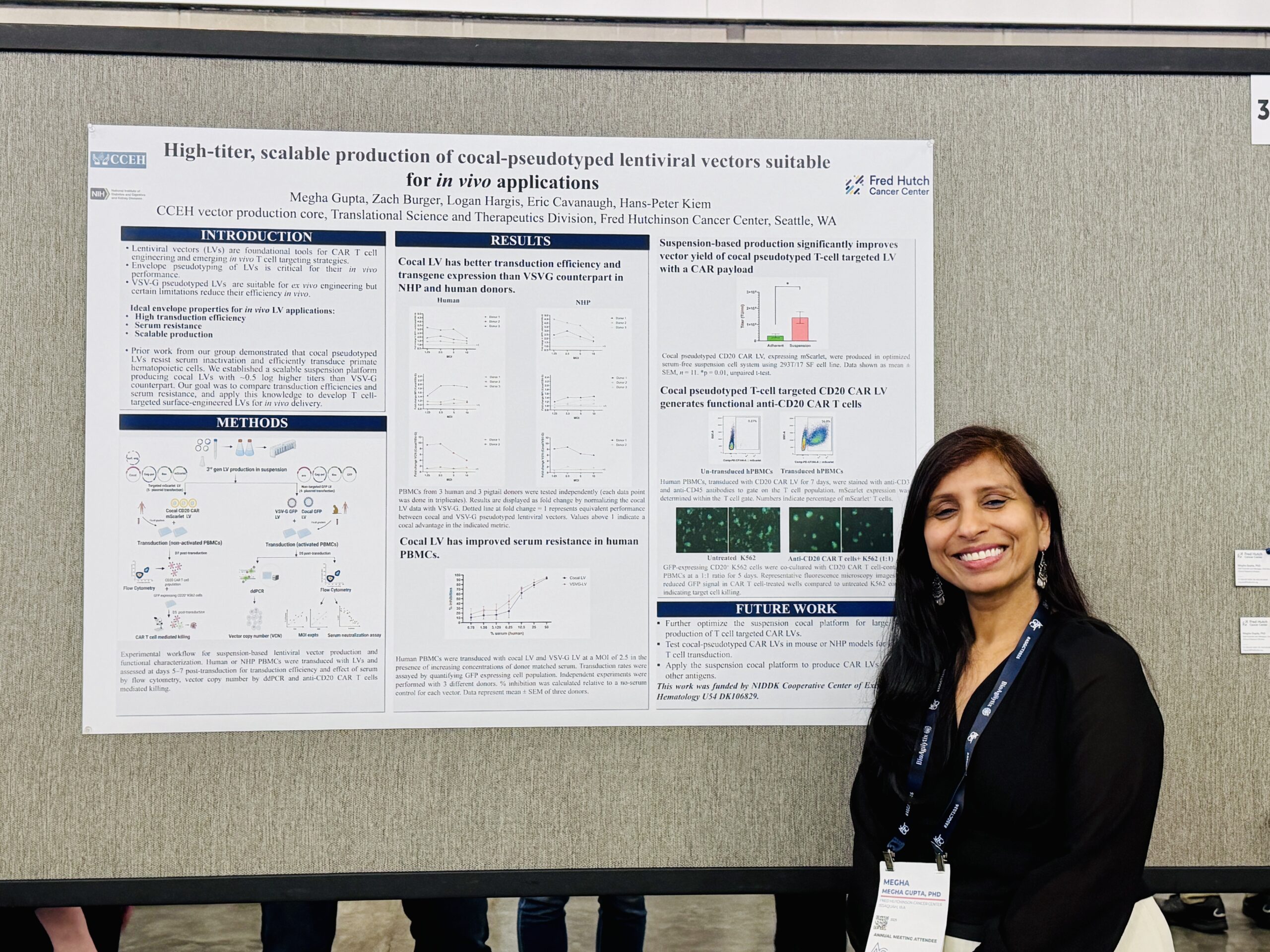
Title of Poster: High-titer, scalable production of cocal-pseudotyped lentiviral vectors suitable for in vivo applications
Category: Ex vivo administration and vector engineering of non AAV viral vectors
Abstract:
INTRODUCTION: Scalable and flexible lentiviral vector (LV) production platforms are essential for advancing gene and cell therapy applications. Envelope choice critically impacts transduction efficiency, serum sensitivity, and cross-species performance; however, systematic evaluation of alternative pseudo types in scalable production systems remains limited. Addressing this gap is particularly important for the success of in vivo gene delivery.
METHODS: We developed a suspension-based LV production platform and generated GFP-expressing vectors pseudo typed with either cocal or VSV-G envelopes. Transduction efficiency and mean fluorescence intensity (MFI) were evaluated in human and pigtail macaque peripheral blood mononuclear cells (PBMCs). Serum sensitivity was evaluated using neutralization assays. Based on the overall performance of GFP-vectors, production of T cell targeted cocal-pseudotyped chimeric antigen receptor (CAR) LVs was optimized in suspension and compared with vectors generated using a conventional adherent system.
RESULTS: Cocal-pseudotyped GFP LVs consistently demonstrated higher transduction efficiency than VSV-G–pseudo typed vectors in both human and pigtail macaque PBMCs. The magnitude of this difference was more pronounced in nonhuman primate PBMCs (10–20%) compared to human PBMCs (8–12%). Cocal-pseudotyped vectors also achieved significantly higher MFI, indicating enhanced transgene expression at the single-cell level, and this was supported by increased vector copy number (VCN). Serum neutralization assays revealed substantially greater neutralization of VSV-G-pseudotyped vectors relative to cocal-pseudotyped counterparts, demonstrating improved resistance of cocal envelopes to serum-mediated inhibition. Leveraging these envelope-dependent advantages, we produced T cell targeted cocal CAR LVs using the suspension platform. CAR vectors manufactured in suspension achieved approximately half-log increase in functional titers compared to vectors produced using an adherent system.
CONCLUSION: Together, these findings demonstrate that our suspension cell platform enables scalable production of cocal-pseudotyped lentiviral vectors with enhanced titers, transduction efficiency and serum resistance. This approach supports robust manufacturing of targeted CAR vectors and provides a strong foundation for translational and preclinical in vivo LV applications.